

Sidelining Young Americans’ Media Habits Will Lose You Elections
New Gen Z news consumption data underscores how COURIER is filling a key void.

This week, Pew Research released a new report showing how young adults are consuming and trusting news in radically different ways than older Americans. It’s a must-read for anyone working in politics and media - especially for those of us building a broad opposition movement to the extremism we see coming out of Washington. Here are a few key findings that stuck out to me:
What Pew says about young adults
Pew found that only 15% of 18–29-year-olds say they follow the news “all or most of the time,” about one-quarter the rate of the oldest adults. They are less likely than any other age group to actively seek out news about politics, government, science, or business, and far more likely to bump into news incidentally while doing other things online. For political news specifically, 70% of young adults say they get it because they “happen to come across it,” rather than seeking it out, a complete inversion of older Americans’ habits.
At the same time, younger audiences are more likely than older adults to say the news makes them feel scared or confused, and less likely to say it makes them feel informed. One in three 18–29-year-olds report that news often makes them feel scared, and one in three say it often makes them feel confused. That emotional response helps explain why they are turning away from traditional formats that feel overwhelming, negative, or irrelevant to their daily lives.
Where Gen Z actually gets news
The clearest headline in this research is simple: young adults live on their phones, and they get their news there. Ninety-three percent of adults under 30 say they at least sometimes get news from digital devices, and they are far less likely than older Americans to rely on television or radio.
In terms of platforms, TikTok and Instagram are at the center of this shift. Adults under 30 are dramatically more likely than every older age group to say they regularly get news on TikTok and Instagram; even compared with 30–49-year-olds, young adults stand out as much heavier news consumers on these platforms. Young adults also use YouTube for news at higher rates than the oldest Americans, and they are just as likely as people in their 30s and 40s to get news from podcasts and email newsletters—suggesting that the social video ecosystem is a gateway into deeper news habits, not a replacement for them.
How COURIER is built to reach these audiences
Taken together, this research both describes the exact audiences that our national COURIER brand has struck a nerve with on these platforms over the past few years — and reinforces how critical a role we are playing by helping to close this audience engagement gap in the broader left-leaning media ecosystem.
On TikTok, where we have over 3.6 million followers networkwide and have received several billion views this year, our audience is overindexed on young adults - 64% of TikTok users who have viewed COURIER content in the past year are under age 34.
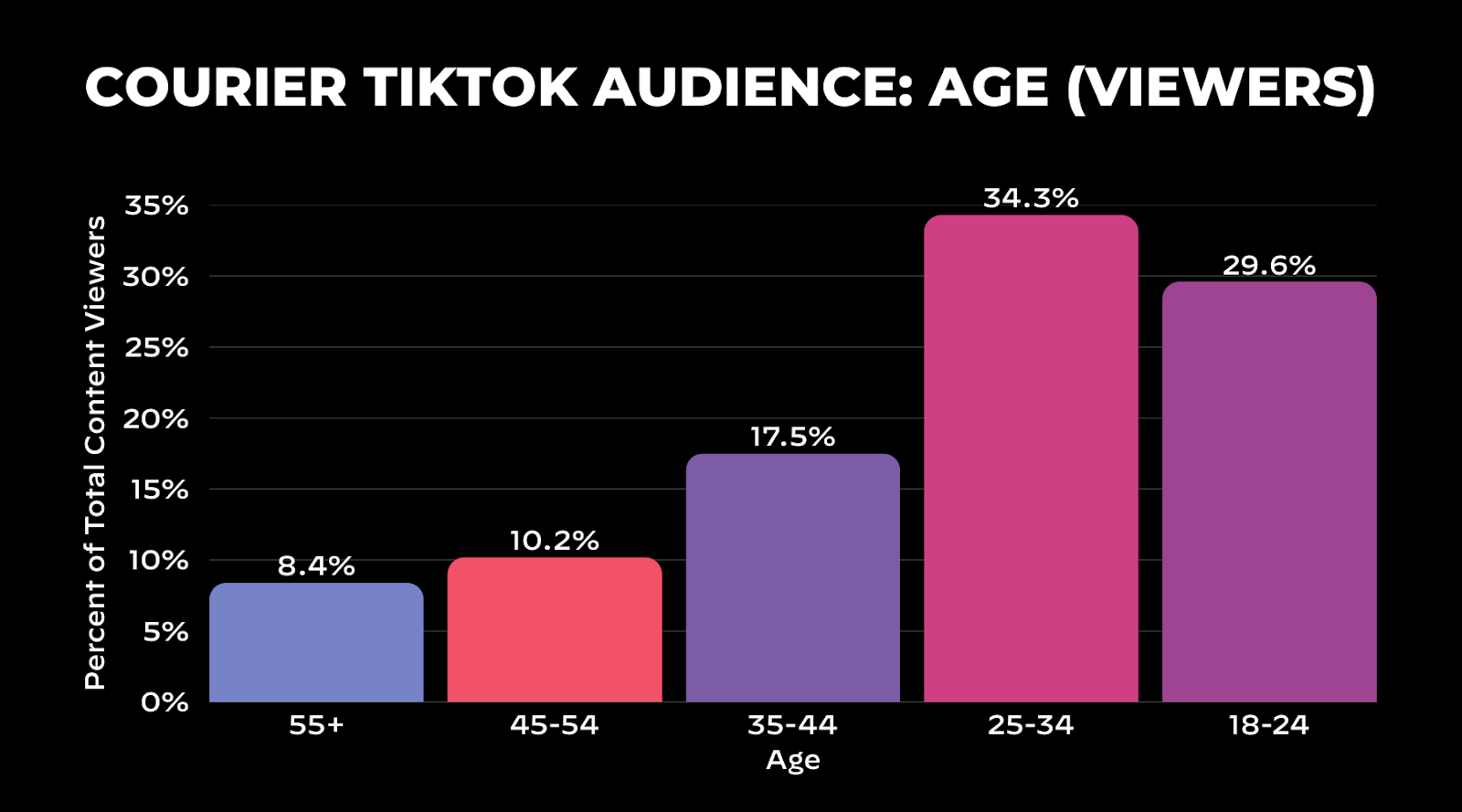
This has made COURIER one of the largest, most-engaged, and fastest-growing news brands on TikTok in 2025.
On Instagram, the picture is very similar, our audience skews much younger than many other left-leaning media accounts, and totals over 1.6 million followers across our network of accounts. 57% of our audience on that platform is under 44 years old.

By the 2028 presidential election, people under the age of 45 will constitute the majority of American voters. Pew’s findings about where and how young people are consuming news underscores the urgent need for the Democratic Party and broader anti-MAGA movement to prioritize investments in growing trusted audiences and reach on TikTok and Instagram in particular, as these platforms have become “the front page” for millions of under-40 voters.
For over six years, our network of local newsrooms and creators at COURIER have met those audiences where they are, in the formats they prefer, with reporting that is transparent about its values and grounded in community. By pairing that social-first content with newsletters, podcasts, and YouTube series that deepen their relationships with our brands and reporters, COURIER is building a modern media ecosystem that not only captures audience attention but turns that attention into long-term brand trust and civic engagement as a result.
When it comes to advancing our collective mission of protecting and strengthening our democracy in America in the immediate and long-term, you would be hard-pressed to find a smarter investment than supporting independent, modern media outlets like COURIER, who are earning the trust right now of the very voters who will decide the fate of our elections for decades to come.
Tara
Join us for two COURIER events next week:
Join BigTentUSA and COURIER Texas—at a special time—Monday, December 8th at 10am ET / 9am CT, for a virtual conversation with Texas State Rep. James Talarico, who recently announced his run for the U.S. Senate. He’ll be joined by Dawn Jones, Texas Organizing Director for COURIER Texas, and independent journalist, Aaron Parnas, for a deep dive into the shifting political landscape in Texas and what’s at stake in the years ahead. RSVP + Zoom link here >>
If you’re in Washington, DC next week, you won’t want to miss COURIER’s end-of-the year soirée uplifting some of our nation’s key voices of resistance as we raise a glass to the courage it’ll take to keep showing up. On Thursday, December 11th, enjoy food and drinks as we come together for thoughtful and unflinching dialogue with journalists, creators, and advocates. Our Courage > Cowardice event will dive into what history has taught us, and how we turn those lessons into action for the battles to come. RSVP + Details here >> (You can register for free until midnight tonight using this code at checkout: CYBERWEEK2025)
What I’m reading this week:
CBS News Editor-in-Chief Bari Weiss Sets Her On-Air Debut: A Town Hall With Erika Kirk (The Hollywood Reporter, 12/2)
“In an unusual move, CBS News has set a town hall with Erika Kirk, the widow of late conservative activist Charlie Kirk and the leader of Turning Point USA. The town hall itself is not unusual (Kirk has been doing a number of media interviews in recent weeks, including the culminating conversation at The New York Times‘ Dealbook Summit on Wednesday evening). But what is unusual is that Bari Weiss, the editor-in-chief of CBS News, will be the one leading the conversation…”
Netflix announces deal to buy Warner Bros. and HBO (CNN, 12/5)
“Netflix has triumphed in the bidding war for Warner Bros. and HBO, announcing a deal that could combine two of the three biggest streamers with one of the largest traditional movie and television studios. If the deal goes through, it will fundamentally reshape Hollywood at a precarious time for the entertainment business.”
U. of Alabama Suspends Black and Female Student Magazines, Citing D.E.I. Guidance (NYT, 12/2)
“Officials told staff members at two student-run publications, called Nineteen Fifty-Six and Alice, that they were not compliant with Attorney General Pam Bondi’s memo on diversity programs.”
The Bubble-Wrapped President (Atlantic, 12/1)
“Trump surrounds himself with those who flatter him in places where he is comfortable…”