

Americans’ “complicated relationship with the news”
...and what we can do about it.

I’ve been talking and writing about this for years: Americans increasingly see news as an obligation or background noise, and not something they actively seek out. That gap in how and whether people seek out news and information has become one of the biggest fault lines in our society, and explains so much about the state of our politics today. It’s also something that the media industry (and old-school political campaign types) have ignored for too long. A new Pew Research Center study out last week laid this out with fresh data, and I wanted to share a few toplines:
First of all, 80% of Americans say people have a responsibility to stay informed when they vote, and 78% say news helps with voting decisions. That’s not surprising. But, only 11% call following the news “extremely important” as a civic duty, and many say it doesn’t help with daily life or being engaged in their communities at all.
Then there’s the exhaustion factor: 52% of Pew respondents said they are worn out by the sheer volume of news. 48% say most of it isn’t even relevant to their lives. Two-thirds have ditched a specific source, and six-in-ten have cut back overall. Just 9% follow the news because they enjoy it.
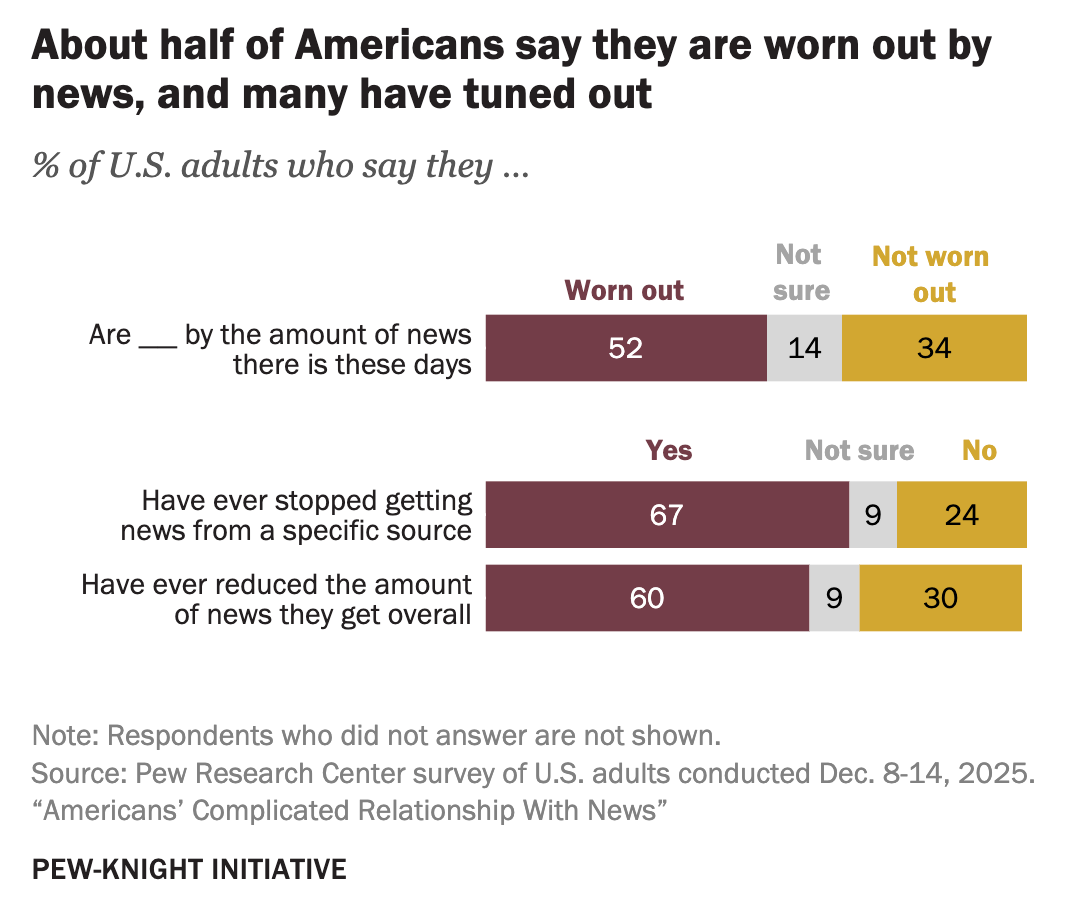
Staying informed by reading or watching the news has become a chore at best, and a threat to our mental health at worst, and one that many Americans would rather not deal with. That has dramatic implications for the fragile state of our Democracy.
It probably won’t surprise you that I place the blame for much of this exhaustion and “tuning out” of the news squarely on the failures of the legacy press, who spent years putting up paywalls and catering to elite audiences while their corporate owners consolidated and shuttered outlets left and right. Couple that with our new era of cowardly, pro-Trump capitulation from major networks and newspapers, and it’s no wonder many audiences are turned off.
These stats present hard truths for those of us who spend all day, every day thinking about how we reach and inform our audiences with relevant information about government, politics, and what’s happening in their communities. But, this current, somewhat sad state of news consumption also presents opportunities for new models to emerge of reinventing news distribution and making content that feels relevant to Americans’ lives.
At COURIER, we’ve spent six years experimenting and growing our strategy along these lines. By combining original reporting via free local newsletters and creator-driven social accounts with community news, lifestyle tips, and on-the-ground reporting, we’re reaching news-avoidant Americans directly in their feeds and inboxes. Year-round, we’re building trust and shifting opinions (and this year, ICYMI, we’re growing)!
So, if you work in media or politics, I hope you’ll take a look at Pew’s report and see it both as a wake-up call and a clear opportunity. The old guard’s failures have created an opening for newer models that reach Americans directly with news content they actually want to consume. Aside from COURIER, there are a number of independent creators and media brands that are growing and reaching audiences effectively in this new environment, and when you come across them, make sure to give them a follow, a share, and your support.
- Tara
Watch: My interview with Kara Swisher
Big Tech has been a prominent force in our culture for decades, but it’s only more recently that they’ve become a prominent and problematic force in our government. Kara Swisher is a journalist known for interviewing almost every tech CEO over the course of a quarter century, so if there’s anyone who knows the ins and outs of how these people think, it’s her.
What I’m reading this week:
Stephen Colbert says CBS didn’t air interview out of fear of FCC (NBC, 2/17)
“Colbert kicked off Monday’s episode of “The Late Show” by saying that the network’s lawyers told him he could not have Texas state Rep. James Talarico on the broadcast.”
X’s Algorithm Pushes Users to Lean More Conservative, Researchers Find (Gizmodo, 2/20)
“In case you had any doubt, Elon Musk’s X has an algorithm that favors conservative content posted by political activists over liberal content or posts by traditional news media accounts, according to a new study published in Nature.”
Trump met with David Ellison days before saying he’s ‘not involved’ in Paramount’s Netflix battle (CNN, 2/12)
“Paramount CEO David Ellison returned to the White House last week to meet privately with President Donald Trump, amid Paramount’s ongoing hostile takeover bid for CNN and the rest of Warner Bros. Discovery. Ellison and Trump had two wide-ranging conversations, according to two sources with knowledge of the meetings…”